
Used Shearing Machine Buying Guide: Blade Gap, Stroke, and Safety
A shearing machine (also called a guillotine shear or plate shear) is the first machine in any sheet metal workflow — you cut the sheet before you bend it. And because it runs every single day, the condition of a used shear matters more than almost any other machine in your shop.
A worn-out shear doesn't just make bad cuts — it produces burred, twisted sheets that ruin your downstream bending and waste material. Here's what I check on every used shearing machine before it ships.
First: size the machine to your work
Before you message any seller, work out:
- Max plate thickness you'll cut (mild steel: 3mm? 6mm? 12mm? 20mm?)
- Max plate width (2500mm? 3200mm? 4000mm? 6000mm?)
- Material — mild steel, stainless, aluminum? (stainless needs ~2× the force)
- Mechanical or hydraulic?
- Backgauge depth (500mm? 1000mm? — how far back can you cut?)
A rough tonnage guide for shearing mild steel:
| Plate thickness | Required shear force per meter |
|---|---|
| 3 mm | ~30 tons/m |
| 6 mm | ~80 tons/m |
| 10 mm | ~150 tons/m |
| 12 mm | ~200 tons/m |
| 20 mm | ~400 tons/m |
Add 15%–20% headroom. Shearing stainless or high-strength steel needs significantly more.
Types of used shears you'll see
Mechanical shear
Old-school, flywheel-driven. Fast cycle rate, cheap used, but loud, hard to adjust, and not great for thick plate. Fine for a small fab shop cutting thin sheet.
Hydraulic swing-beam shear (QC12Y series)
The most common used shear on the market. Popular models: QC12Y-4×2500, QC12Y-6×3200, QC12Y-12×3200. Ram swings in an arc, hydraulically driven. Reliable, simple, cheap parts.
Hydraulic guillotine / beam shear (QC11Y series)
Straight up-and-down ram motion. Better for thick plate and angled cuts, generally higher precision and heavier build than swing-beam. More expensive used.
The 8-point inspection
1. Blade condition and blade gap
This is the most important thing on a shear.
- Look at the upper and lower blades directly.
- Blades should be ground smooth, with no nicks, cracks, or rolled-over edges.
- Minor wear on the edge can be re-ground (usually 3–4 times before the blade is scrap).
- Blade gap adjustment: ask the seller to demonstrate adjusting the gap for different material thicknesses. The gap should be roughly 5%–10% of material thickness.
- If the gap adjustment is seized or doesn't move, that's a big problem.
2. Ram parallelism and squareness
- The ram must come down parallel to the lower blade across its full length.
- On a video inspection, ask for a feeler gauge or paper test: a sheet of paper should be cut evenly along the whole length.
- One side cutting deeper than the other = worn pivots, bent tie rods, or hydraulic imbalance.
3. Hydraulic system
- Watch a full cut cycle on video. The ram should come down fast, cut cleanly, and return smoothly.
- Listen for knocking from the pump or a jerky return.
- Check the oil condition and look for leaks under the tank.
- On swing-beam shears, there's often an accumulator for fast return — ask if it holds pressure.
4. Backgauge
- Run the backgauge full travel. It should move smoothly and lock firmly.
- On NC models, jog it to a position and measure with a tape — screen reading should match actual position within ±1mm.
- A worn backgauge means your cut lengths won't repeat.
5. Hold-down feet
Before the ram cuts, hold-down cylinders press the sheet down. Test each one on video:
- Every hold-down foot should contact the sheet firmly.
- Weak or leaky hold-downs = the sheet lifts during cut, producing a twisted or burred edge.
6. Stroke rate and foot pedal
- Run the machine through 5–10 cycles on video. Cycle rate should be consistent.
- Test the foot pedal — it should trigger a single clean stroke each press, not double-fire.
- Check the manual mode and single-stroke mode both work.
7. Safety systems (this is non-negotiable)
Shears are one of the most dangerous machines in a fab shop. Do not buy one with bypassed safety:
- Light curtains / safety bars along the front opening — interrupt them mid-cycle and the ram must stop immediately.
- Emergency stops on both sides.
- Two-handed control or guarded foot pedal.
- Rear safety guard / light curtain on the back side.
- Hold-downs must release after the cut, not during.
If a seller says "we removed the light curtain because it got in the way" — walk away.
8. Frame and welds
- Walk the frame. Look for cracks around the ram pivots, the cylinder mounts, and the base welds.
- A cracked frame = scrap.
- Check hold-down cylinders for bent rods.
Red flags
- Seller refuses to cut a test piece on video.
- Blade edges chipped, cracked, or badly worn.
- Ram visibly tilted when descending.
- Major hydraulic leaks.
- Safety devices bypassed or removed.
- Backgauge won't hold position.
- Price 30%+ below comparable machines.
What you'll pay (FOB China)
| Type | Typical used price |
|---|---|
| Small mechanical shear (≤3×1500) | $1,500 – $3,500 |
| Hydraulic swing-beam QC12Y-4×2500 | $3,500 – $6,500 |
| Hydraulic swing-beam QC12Y-6×3200 | $5,000 – $9,000 |
| Hydraulic swing-beam QC12Y-12×3200 | $9,000 – $16,000 |
| Guillotine shear QC11Y-16×3200 | $15,000 – $28,000 |
| CNC shear with automatic backgauge | +$3,000 – $8,000 on top |
A few practical tips
- Blade gap is thickness × 8% for mild steel, × 12% for stainless, × 6% for aluminum.
- Budget a set of spare blades — they wear and need re-grinding.
- Confirm voltage: most Chinese shears are 380V/50Hz 3-phase.
- If you're already buying a press brake, look for a matched brand — tooling and controls are often similar.
Final thought
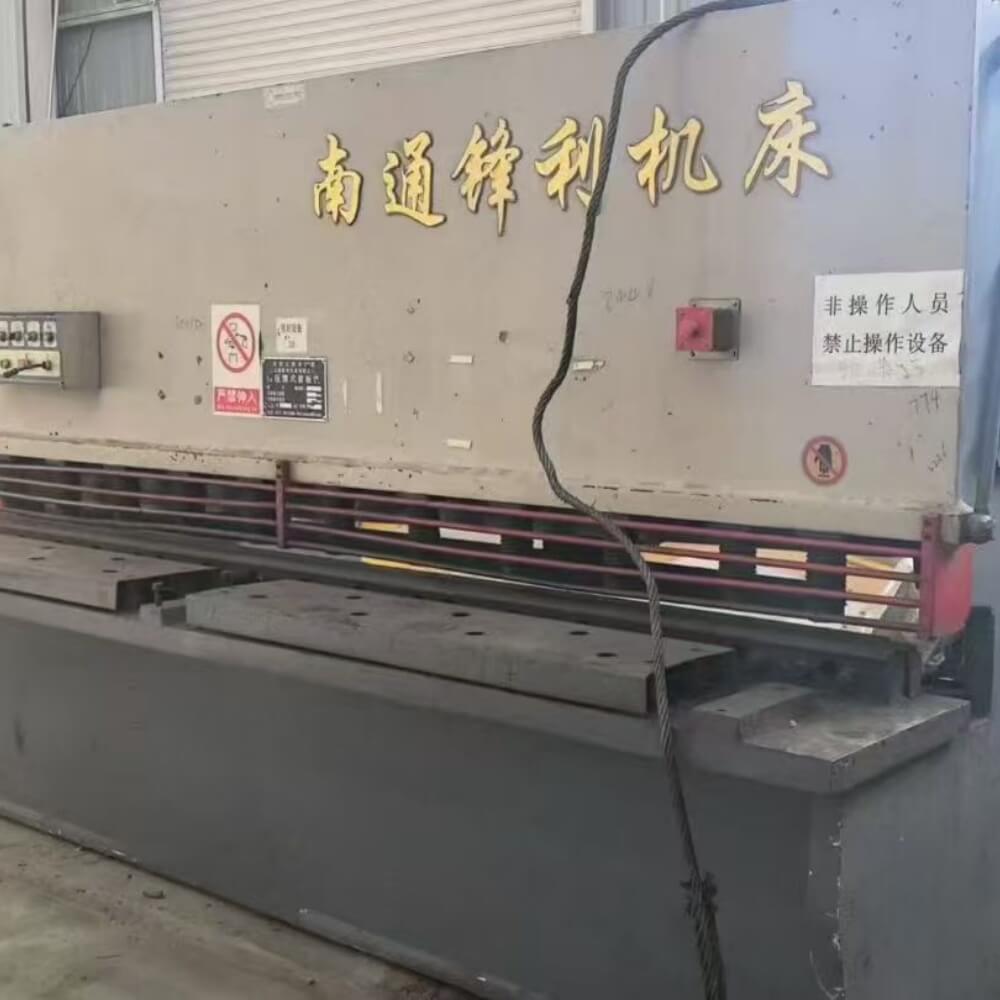
A used shear that has sharp blades, parallel ram motion, and working safety gear will run for 20+ years. The hydraulics are simple, the frame is massive, and everything else is wear parts. Skip any machine where the seller won't cut a test piece on camera — that one detail tells you everything.
Looking for a used shearing machine? We stock hydraulic swing-beam and guillotine shears from 4×2500 up to 20×4000 in our China warehouse. Every machine is video-tested with a real cut, and blade condition is reported honestly. Contact us with your required thickness and width, and we'll send you real options with a straight FOB quote.