
Used Press Brake Buying Guide: Tonnage, Inspection, and the Traps
A press brake is one of the more expensive machines in any sheet metal shop — and one of the easiest to buy wrong. Get the tonnage wrong and you can't bend half the jobs you wanted. Get the condition wrong and you're looking at a $5,000 hydraulic rebuild.
Buying a used press brake can save you 50%–70% compared to new. But press brakes have a few specific failure points that a casual buyer misses. Here's what I check on every used press brake before it leaves our warehouse.
First: work out the tonnage you actually need
This is the #1 mistake. People buy "a 100-ton press brake" because it sounds right, then find out they can't bend 6mm mild steel over 2 meters.
Use the rough formula:
Tonnage ≈ 80 × (material thickness in mm)² × (length in meters) ÷ (die opening in mm)
Rough guide for mild steel (4V die, standard bottom bending):
| Material thickness | Tonnage per meter needed |
|---|---|
| 1.5 mm | ~4 tons/m |
| 3 mm | ~12 tons/m |
| 4 mm | ~20 tons/m |
| 6 mm | ~45 tons/m |
| 8 mm | ~80 tons/m |
| 10 mm | ~120 tons/m |
Multiply by your bending length to get the machine tonnage. Then add 20% headroom — you'll be glad you did when a customer brings high-strength steel or stainless.
Also decide:
- Working length (2500mm? 3200mm? 4000mm? 6000mm?)
- CNC / NC / manual?
- Tonnage (40T? 100T? 160T? 200T? 400T?)
- Backgauge (manual? NC single-axis? CNC multi-axis with R-axis and depth?)
Used press brake types you'll see
Mechanical / old hydraulic (manual)
Cheapest, but slow, hard to set accurately, and often 20–30 years old. Good for a one-man shop doing simple brackets.
NC press brake (single or two-axis backgauge)
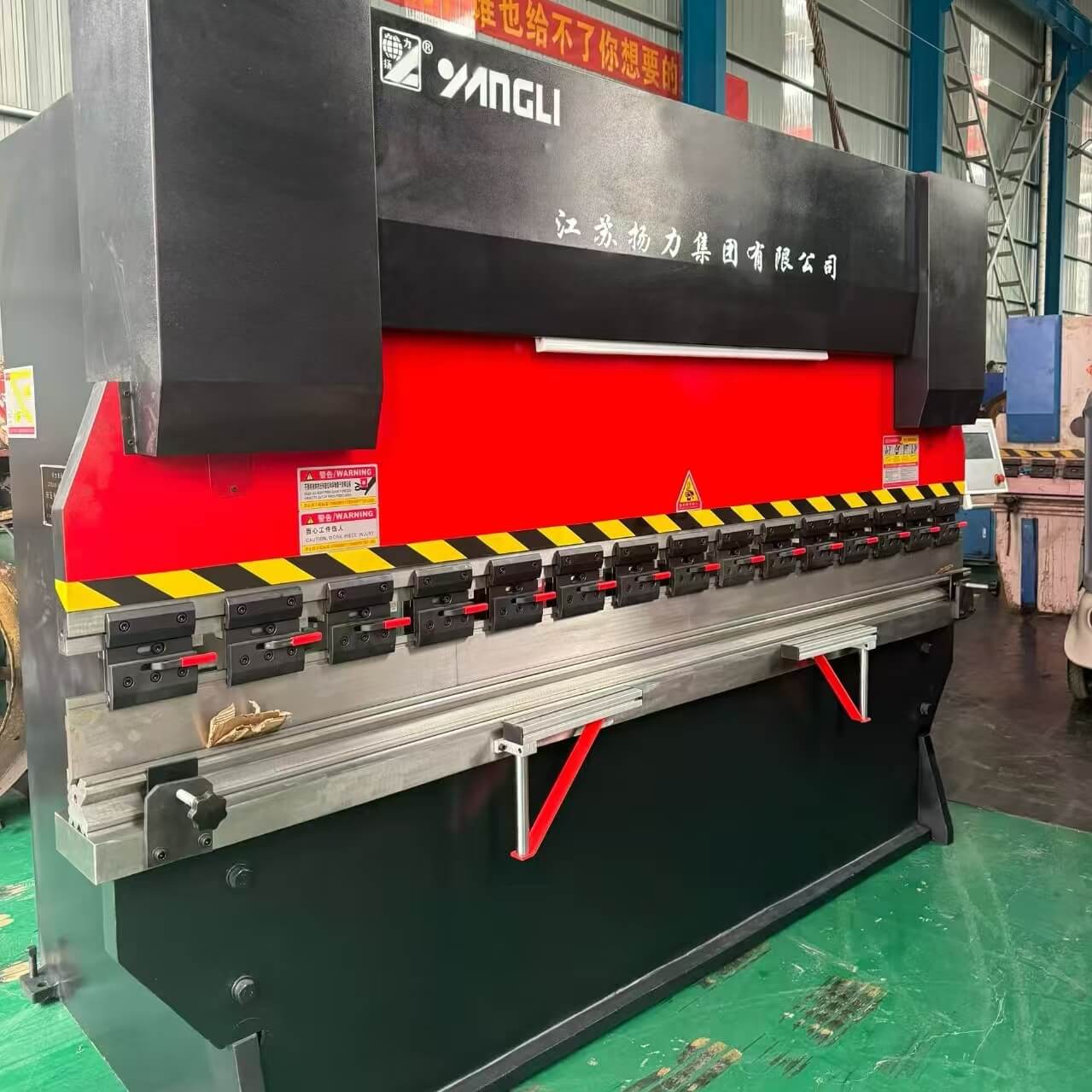
The sweet spot for most small shops. You program the bend angle and backgauge position, the machine repeats it. Popular Chinese models: WC67Y-40/2500, WC67Y-100/3200, WC67Y-160/3200.
CNC press brake (multi-axis, crowding correction)
High-end used European machines (Amada, Beyeler, Trumpf, Hämmerle) or newer Chinese CNC models (WE67K series). Can handle complex air bending, angle correction, and multi-axis backgauges. Price is higher, but so is throughput.
The 8-point inspection
1. Ram parallelism and the bed
This is the single most important thing on a press brake.
- Put a long straight edge and a dial indicator across the bed.
- Cycle the ram down through full stroke.
- The ram must stay parallel to the bed across its full length. Difference should be under 0.05–0.10mm over 3 meters.
- If one end comes down before the other, the machine will bend tapers. This usually means a hydraulic synchronization problem or worn slide guides — expensive to fix.
2. Hydraulic system
Ask the seller to run the machine on video:
- Watch the ram come down at fast approach speed, then slow to bending speed.
- Listen for knocking from the hydraulic pump.
- Check the oil level and oil condition — milky oil means water got in; black gritty oil means it's never been changed.
- Look under the machine for oil leaks. A few damp hoses are normal; puddles are not.
3. Crow / deflection compensation
Long beds flex under load. Better machines have a mechanical or hydraulic crowning compensation on the lower bed.
- Ask the seller: "Does the bed have crowning? Mechanical or hydraulic?"
- No crowning on a 3200mm+ machine means your bends will be slightly angled in the middle of the sheet.
4. Backgauge
- Run the backgauge full travel forward and backward.
- It should move smoothly, stop accurately, and hold position.
- On a CNC machine, jog it to a position and measure with a tape — does the number on the screen match reality?
- Worn ball screws on the backgauge = it can't repeat accurately. That's a $500–$1,500 fix.
5. Control system
- Ask the seller to boot the controller in the video. Wait — does it take 5 minutes? Does it throw errors?
- Popular controls: Delem DA41/DA52, Cybelec, Estun, Siemens. Avoid weird unbranded Chinese controls you can't get support for.
- Program a simple bend on camera. Does the machine repeat the angle?
6. Tooling (punches and dies)
This is where buyers get stung. A press brake sold "without tooling" needs another $1,000–$5,000 to actually start working.
Ask exactly what's included:
- Upper punch (straight gooseneck? radius?)
- Lower V-die (which opening widths? 4V block?)
- Holders and clamps
- Are the edges ground or nicked?
Check the die edges for chips, cracks, and hammer marks.
7. Safety systems
- Light curtains / safety beams — do they actually stop the ram when you break the beam?
- Emergency stop buttons on both sides.
- Two-hand controls (if it's a manual machine).
- Foot switch with a proper guard.
Don't buy a press brake with missing or bypassed safety. It's not just a legal issue — it's how people lose fingers.
8. Frame weldment and foundation
- Walk around the machine. Look at the welded frame for cracks, especially around the ram guides and where the cylinders mount.
- A crack in the frame = the machine is scrap.
- Check the leveling bolts and the machine feet.
Red flags
- Seller won't run the machine under load on video.
- Ram visibly tilted when descending.
- Major oil leaks under the tank.
- Control screen flickering or showing constant errors.
- Cracks in the frame welds.
- Price 30%+ below comparable listings.
- "Bends fine, we just don't need it anymore" but refuses a test bend.
What you'll pay (FOB China)
| Type | Typical used price |
|---|---|
| Manual / old mechanical press brake | $1,500 – $4,000 |
| NC WC67Y-40/2500 | $3,500 – $6,500 |
| NC WC67Y-100/3200 | $5,000 – $9,000 |
| NC WC67Y-160/3200 | $8,000 – $14,000 |
| CNC WE67K-100/3200 (Delem control) | $12,000 – $22,000 |
| Used European CNC (Amada/Beyeler class) | $20,000 – $50,000+ |
Tooling, shipping, and import duty are on top of these numbers — budget 20%–30% extra for landed cost.
A few practical tips
- If you're bending stainless or aluminum, add tonnage — they need more force than mild steel.
- Bigger V-die opening = lower tonnage but a bigger inside radius. Standard rule: V-die = 8× material thickness for mild steel.
- Buy a machine with at least 20% tonnage headroom. Running a press brake at 100% capacity all day shortens its life.
- Confirm the voltage (Chinese machines are usually 380V/50Hz 3-phase).
Final thought
A used press brake will serve a shop for decades if the ram is parallel and the hydraulics are healthy. Everything else — controls, backgauge, tooling — is replaceable. That's what to focus on when you watch the video inspection.
Skip the ones that look "too cheap to be true." They almost always are.
Looking for a used press brake? We stock NC and CNC press brakes from 40T to 400T in our China warehouse — every machine is video-run, ram-parallelism checked, and pressure-tested before shipment. Contact us with your required tonnage, length, and material, and we'll send you real options with a straight FOB quote.